
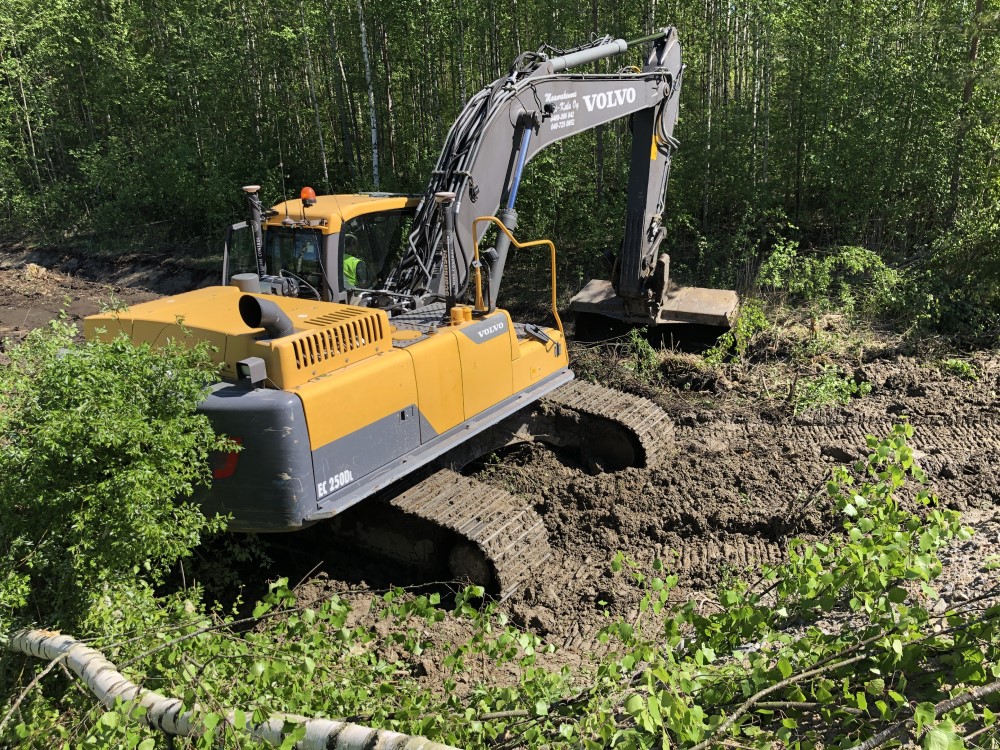
Soil, groundwater or sediments are only remediated if an area is found in surveys to be contaminated as well as if it is determined to be in need of remediation due to an environmental or health risk. The Soil Protection Group of the Finnish Supervisory Agency (in Turku and Helsinki, the City) approves the research results and risk assessment, while also determining the final need for remediation. The aim of remediation is to bring an area into a state where it will not cause any environmental or health hazards.
The polluter is responsible for remediating a contaminated area. If the polluter cannot be identified or held liable, or if the contamination occurs with the consent of the property owner, the property owner shall be required to remediate the area. In old cases, questions of responsibility are often unclear, and if the responsible party cannot be ordered to remediate, responsibility for remediation is ultimately left to the municipality.
What to do when remediating a contaminated area
- Order a remediation plan from a qualified environmental expert or consultant. Implementation of a PIMA (contaminated soil) project requires specialised expertise.
- Submit a notification for remediation of the contaminated area (PIMA notification) to the Soil Protection Group of the Finnish Supervisory Agency (in Helsinki and Turku, to the City) at least 45 days prior to the start of work. The agency will make a decision on remediation (PIMA decision), in which orders concerning remediation are issued.
- Order an environmental control of the site and, if necessary, a remediation plan from a qualified environmental expert or consultant.
- Have the area remediated in accordance with the orders issued.
- Submit a final report on remediation and submit it to the Soil Protection Group of the Finnish Supervisory Agency (or in Helsinki and Turku, to the City) for approval.
Reserve enough time for the planning and notification procedure
A remediation plan for remediation of soil is usually prepared by an environmental expert or consultant hired by the contracting party. After this, the Soil Protection Group of the Finnish Supervisory Agency (in Helsinki and Turku, to the City) is notified of the remediation in a PIMA notification, which is also accompanied by a remediation plan. Notice must be given at least 45 days before the work is due to begin.
Remediation process in brief. For more detailed information, see, for example, the ‘Guidance to the subscriber on the contaminated site project’:
- Remediation plan
- PIMA notification
- PIMA decision (official)
- Remediation
- Final report (to the agency)
The Soil Protection Group of the Finnish Supervisory Agency (in Turku and Helsinki, the City) issues a PIMA decision on the basis of the remediation plan, which determines the objective and practical implementation of the remediation. Please note that, for this reason, a possible government grant for remediation may only be applied for after the final PIMA decision has been issued.
After the PIMA decision, it is possible to proceed to competitive tendering and procurement of a contract as well as the actual remediation. In practice, remediation is supervised by an environmental engineering expert, and the actual remediation should also be ordered from an expert contractor.
Remediation can be conducted:
- on-site, without excavating earth or transferring groundwater (in-situ)
- by excavating and treating soil or groundwater on site (on-site)
- by transferring soil or groundwater elsewhere for treatment (off-site).
The treatment and placement of excavated soil is regulated by the Waste Act.
The Soil Protection Group of the Finnish Supervisory Agency (in Helsinki and Turku, the City) monitors the achievement of the project objectives and ensures that remediation is conducted in accordance with the PIMA decision. Finally, a final remediation report is drafted, describing the implementation and results of the work. The report is submitted for approval to the Soil Protection Group of the Finnish Supervisory Agency (in Turku and Helsinki, to the City), which may request supplementation or clarification of the report before it is approved. In the final report, the authority ensures that the remediation has been conducted in accordance with the PIMA decision and that the project objectives set in it have been achieved.
Remediation costs
In particular, the cost of remediation depends on whether only soil is being remediated or groundwater and/or sediment will also be included in the remediation. The overall cost level of remediation is based on risks in the area and the desired level of remediation. The cost is influenced by numerous other site-specific conditions and a variety of other factors, such as:
- the surface area of the site to be remediated and the depth of the contamination (a small site is relatively expensive, as the control and other fixed costs may be the same as for a large site)
- location (transport and travel costs);
- location in a groundwater or nature reserve;
- soil quality and groundwater properties;
- selection, quantities, concentrations and properties of contaminants
- need for preparatory measures (e.g. clearing trees, marking cables and taking the built environment into account)
- need for the demolition of buildings
- need for special equipment
- remediation method
- official regulations (PIMA decision)
- water conditions (need for water pumping)
- transport and receiving charges for contaminated soil (substantial cost at soil replacement sites)
- need for landscaping and restoration, especially in yard areas
- dates and other details of the tendering process (e.g. season, market situation)
- urgency and timetable (additional costs may be incurred by an urgent timetable as well as delays).